My Urchin was scanning faster than it needed to
In the previous post, I got my Urchin measurement board down to about 19.8 µA in SYSTEM_OFF. That required dropping its Bluetooth connections and rebooting when a local key woke it. It was an interesting overnight experiment, but the daily-budget example had an inconvenient conclusion: active time still accounted for most of the charge.
This time I looked at the keyboard while it was doing something.
There are two results worth keeping from this first set of measurements. Short settling waits and paced scans brought the held-switch average from about 4.30 mA to 2.07 mA. Repeatedly tapping the same switch brought it from 2.66 mA to 1.56 mA. Constructing and dropping the display’s SPI driver between operations did not show a useful net saving.
Whether that buys more time between charges is still an open question. These are short bench comparisons, with only one populated switch on this measurement board. It can tell me quite a lot about scanning, and much less about typing a sentence with overlapping keys.
Start with the baseline we actually built
The earlier articles followed display sleep, split discovery, connection subrating, and the low-frequency crystal. This experiment keeps those questions separate. I am not comparing an old release with a new image containing every change I could think of.
The prepared images start from Urchin revision 580db2ce, with all four variants using the same published RMK revision 0d9c3020. They were built with Rust 1.100.0, in release mode, with locked dependencies. The recorded build working tree was clean.
That RMK revision includes the rebased ordered tap-hold work and an upstream API/configuration migration. Updating RMK is a baseline change, not an active-power optimization. The older articles’ numbers are useful context, but they are not interchangeable controls for these captures.
I prepared four variants:
| Variant | Active matrix scanning | Display SPIM driver |
|---|---|---|
| Baseline | Existing scan policy | Retained between operations |
| Matrix | Short settling wait and 1 ms active-scan gap | Retained |
| SPIM | Existing scan policy | Constructed and dropped for each operation |
| Both | Experimental matrix policy | Constructed and dropped for each operation |
None changes the BLE interval policy, regulator settings, external LF crystal configuration, display content policy, or 16 ms COM-maintenance cadence. The debounce setting remains 5 ms.
The PPK2 was in source-meter mode at 4,200 mV. These new captures measure the powered measurement board, not the display supply or the SPIM peripheral in isolation. The main comparison windows are all 10 seconds long. I use the PPK2’s whole-window average and charge, not the height of the turquoise envelope.
A clean bond is not a connected keyboard
My first capture was not a useful established-connection comparison. I had flashed both but hadn’t paired the keyboard.
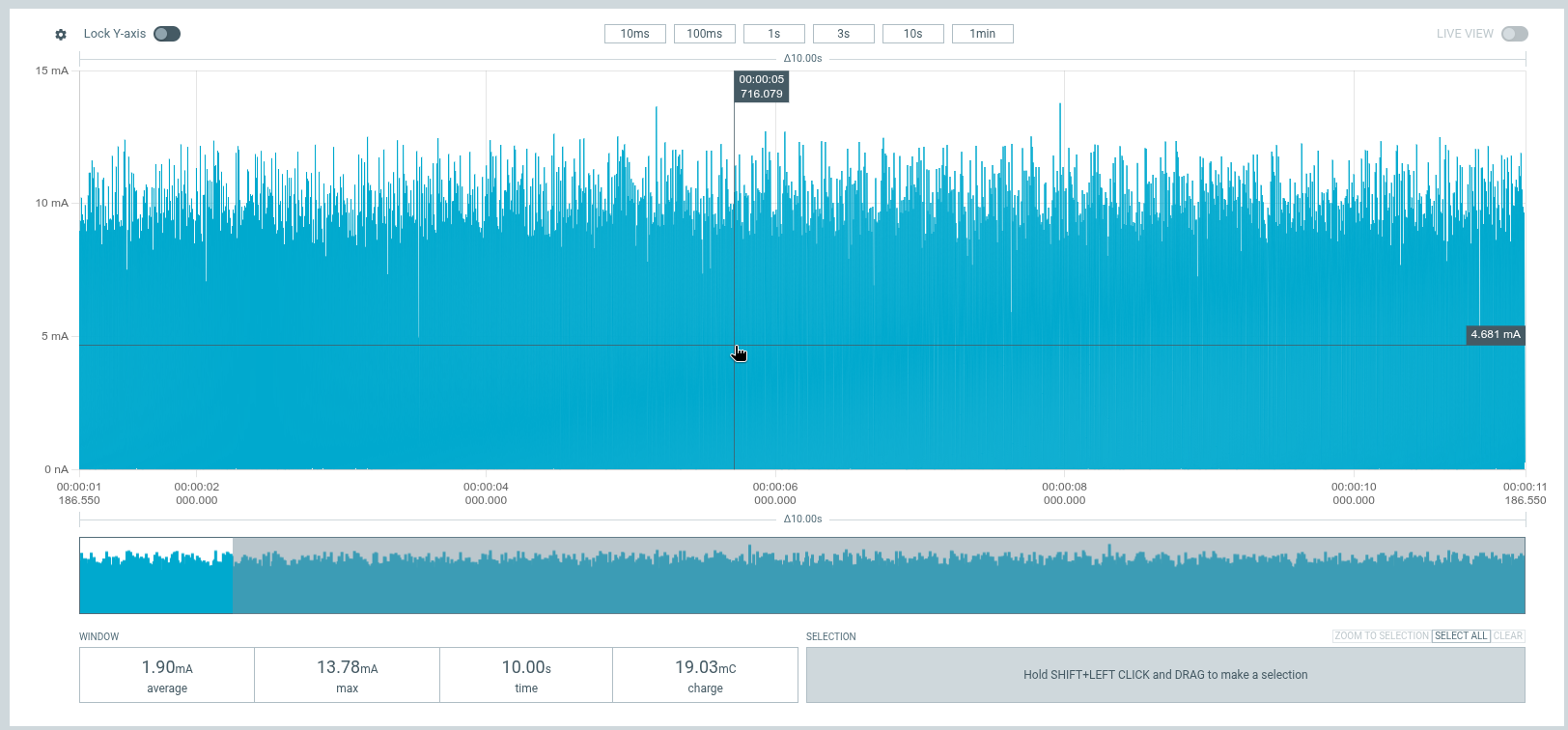
Retained as a record of the setup mistake. Its 1.90 mA is not an active typing result and is excluded from the workload comparisons below.
For the tests, I prepared separate images with RMK’s [storage] clear_storage = true. They clear all stored settings and bonds on every application boot, not merely after flashing. That makes it possible to start from clean stored state, provided I also remove the old host record and pair again. It clears saved mappings and split bonds too; this is temporary test firmware, not how I want the daily keyboard to behave.
On Linux, a Bash script removes the measurement keyboard’s host record, discovers it, pairs through a persistent agent, trusts it, and connects. It checks the resulting state rather than declaring success because a CLI command printed a friendly sentence. It does not establish the separate connection between keyboard halves.
The script had its own fairly embarrassing power-test distraction. I treated bluetoothctl --timeout 30 as a maximum wait. BlueZ keeps completed commands alive for the full duration. Four commands before scanning could therefore consume roughly two minutes while the keyboard’s advertising window disappeared.
A read-only check on the host made that obvious: show took 5.025 s with --timeout 5, versus 0.022 s without it. One-shot commands now use an external maximum timeout. The script also reads ServicesResolved over D-Bus because this BlueZ version doesn’t print that property in bluetoothctl info.
There is a second timing detail to finish recording. RMK waits five seconds before requesting a 15 ms host connection interval, then waits another five seconds before requesting 7.5 ms. Those requests use peripheral latencies of 30 and 60 respectively. Requests are not proof of what the host accepted.
The pairing script initially waited only five seconds before reporting readiness. For subsequent runs I want a consistent longer settling period and an HCI capture of the actual accepted parameters, as in the connected-sleep investigation. I did not record negotiated parameters or exact post-connection timing for each of the first captures below. They remain preliminary results, not a fully controlled BLE benchmark.
Two changes to the scanner, not to the matrix wiring
The matrix experiment changes firmware timing. The pins, physical switches, layout, and debounce configuration stay put.
The first change is the settling wait after a scan output is driven high. Baseline uses:
Timer::after_micros(1).await;The prototype uses:
cortex_m::asm::delay(64);The nRF52840 CPU runs at 64 MHz, so this is nominally a short 1 µs busy-wait without scheduling an asynchronous timer. Our Embassy clock runs at 32,768 Hz: one tick is about 30.5 µs. Asking an RTC-backed timer for one microsecond doesn’t make it a calibrated one-microsecond electrical delay. The replacement isn’t a calibrated delay either; actual settling time still needs checking on the pins.
The second change is the more obvious power experiment. While a key is held, or debounce is in progress, baseline continues rescanning without an explicit gap between complete active passes. The prototype adds:
Timer::after_millis(1).await;That bounds sustained polling to roughly 1,000 passes per second or less, including scan and scheduling overhead. It gives the executor a waiting interval instead of immediately beginning the next pass.
When no key requires rescanning, the scanner still waits on GPIO. There is no new periodic idle poll and no fixed 1 ms delay inserted before the first scan after GPIO wake. The prototype also yields after idle waits so an immediate GPIO error or spurious condition cannot create a cooperative-executor spin.
The pinned scanner source contains both timing changes. The first measurements use them together. I then restored the original settling timer to see how much of the improvement remained with pacing alone.
Hold one switch and complete the four-way comparison
The measurement board’s populated key is physical F. In my layout, it is MT(F, LCtrl): a short tap is F, and a sustained hold normally becomes Left Ctrl. “Held F” below means holding that physical switch, not making the host repeat the letter F.
That keeps the local scanner active and gives the variants a simple workload to compare.
| Held physical F | Average current | Maximum | Charge over 10 s |
|---|---|---|---|
| Baseline | 4.30 mA | 12.73 mA | 42.98 mC |
| Matrix | 2.07 mA | 14.29 mA | 20.72 mC |
| SPIM | 4.36 mA | 12.68 mA | 43.60 mC |
| Both | 2.05 mA | 13.42 mA | 20.47 mC |
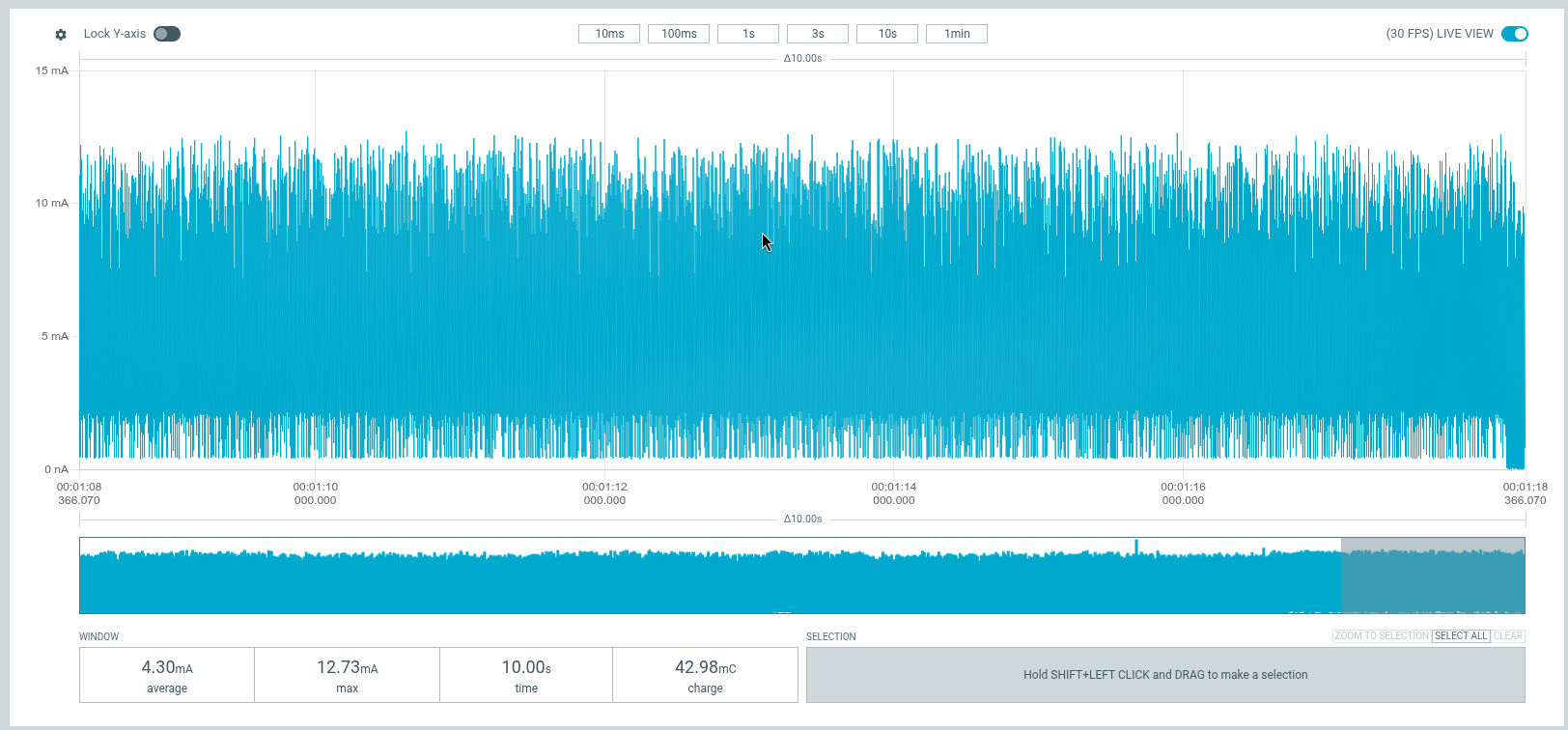
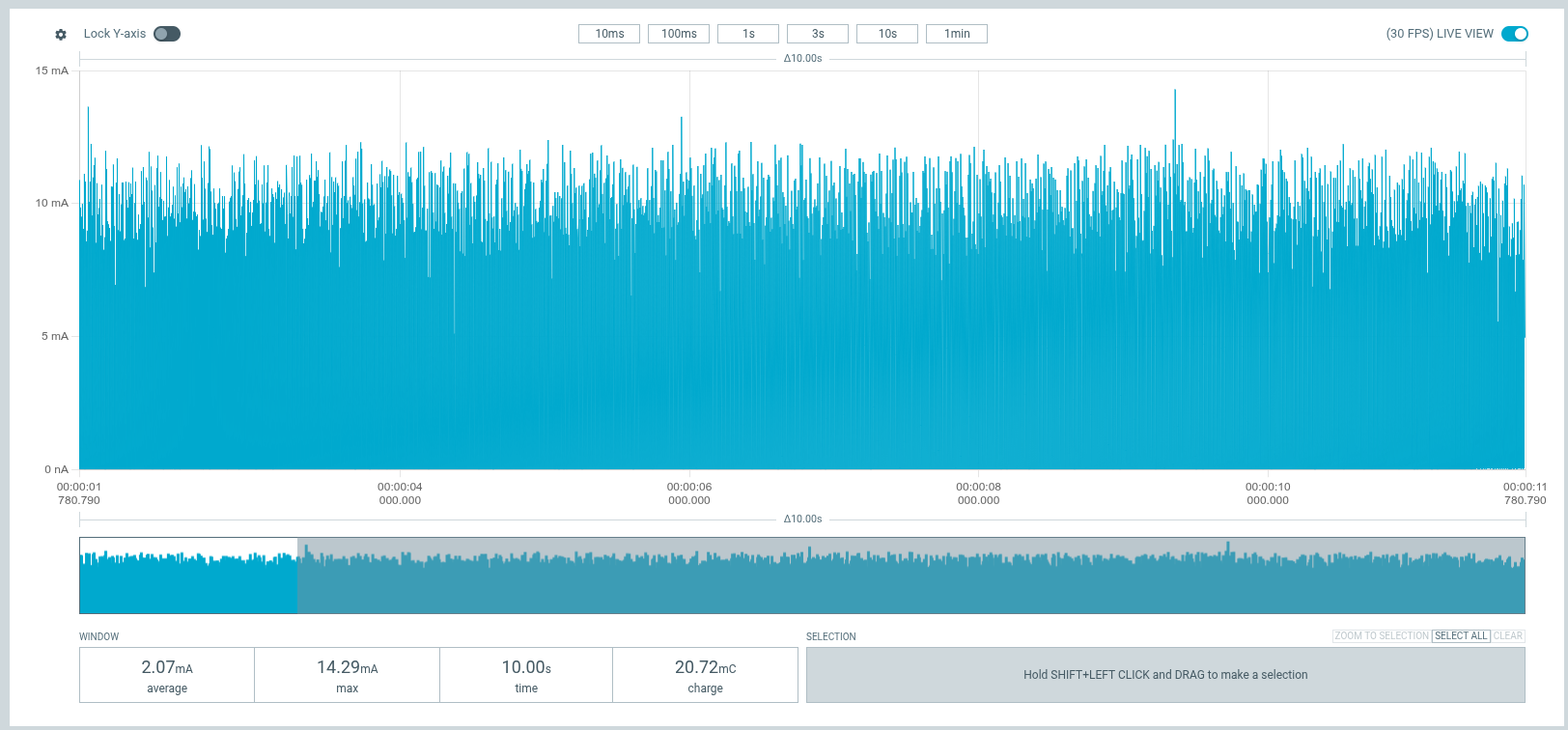
The matrix capture still has tall peaks. The improvement is in average current and integrated charge, not a reduction in peak amplitude.
Matrix-only uses about 52% less charge than baseline in these windows. Both is nearly the same as matrix-only.
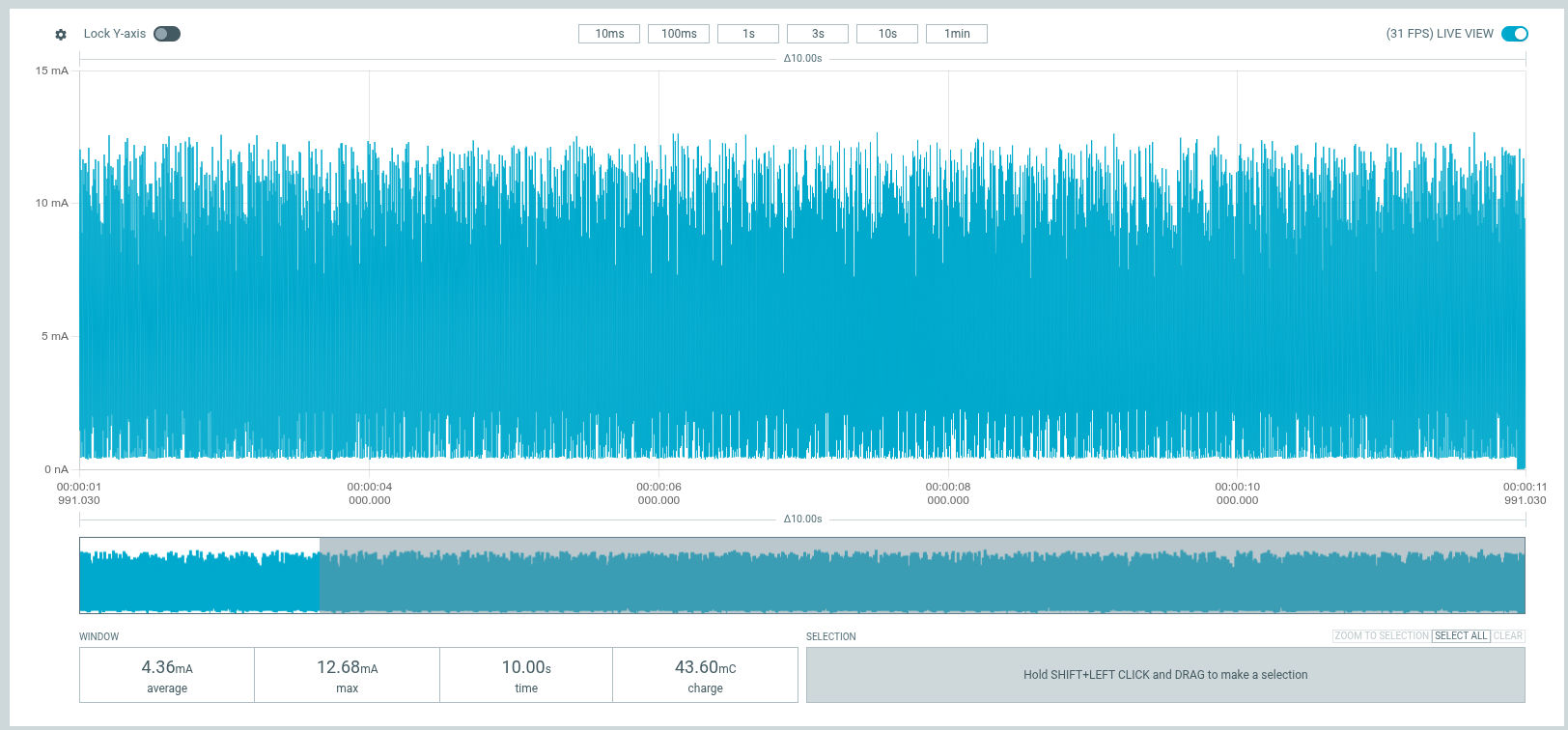
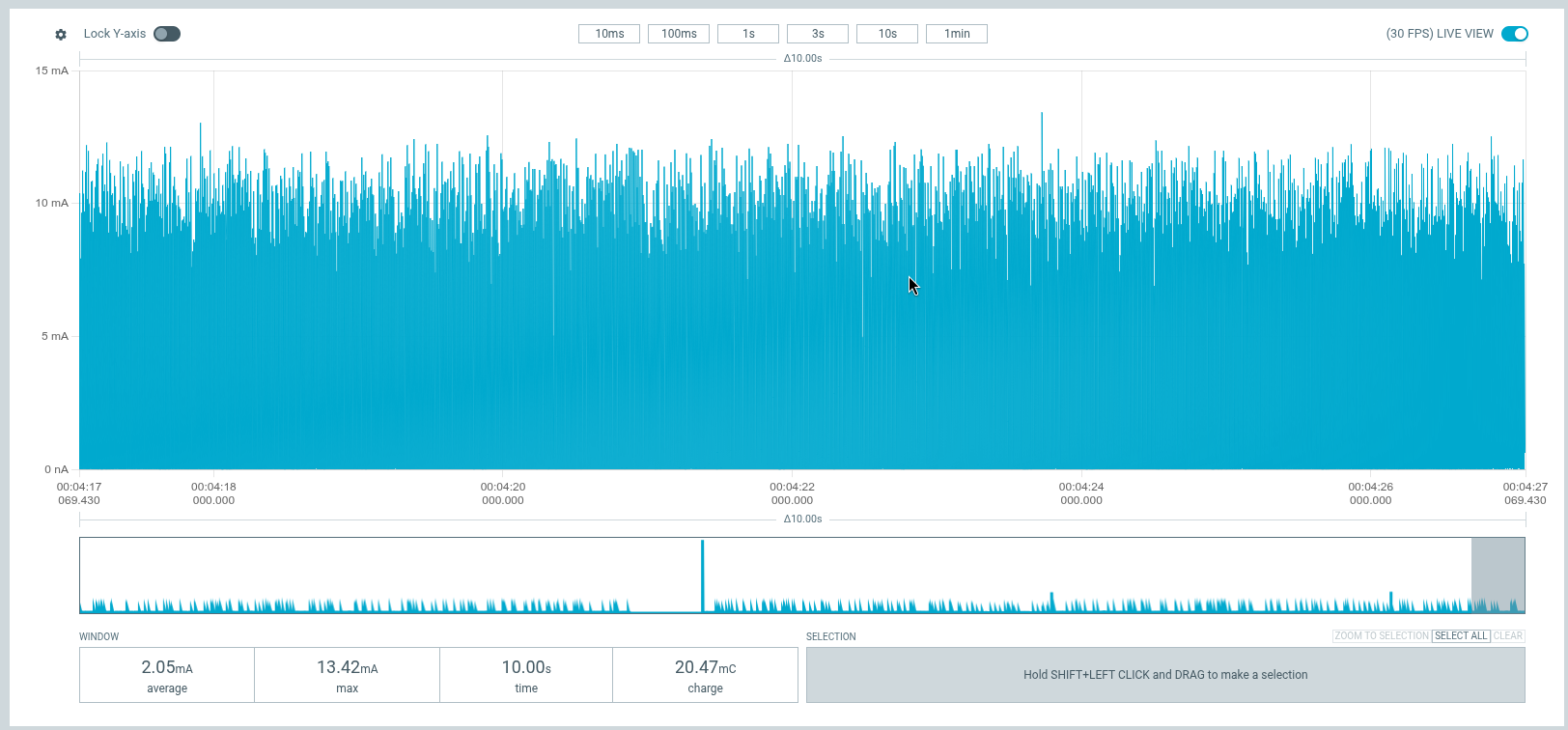
These are single captures per variant, not repeated trials with error bars. The pattern nevertheless points in a useful direction: the matrix variant accounts for the substantial held-switch reduction. The tiny difference between matrix and both doesn’t establish another saving from SPIM.
The display-driver lifetime wasn’t the missing milliamp
The SPIM variant retains ownership tokens and configuration between operations, but constructs the HAL driver for each display operation, flushes, and drops it afterward. Driver drop disables the peripheral; SCK and MOSI are then parked low.
It keeps the existing DMA cancellation protection. An unfinished transfer still has to stop before its buffers and driver can be released. As in the first investigation, removing a safety mechanism isn’t the way to make this number smaller.
SPIM-only came out slightly above baseline in the held-switch test: 4.36 mA versus 4.30 mA. I don’t have enough repeated measurements to call that small difference a regression. I certainly don’t have evidence of a useful saving.
That doesn’t establish the electrical cost of “keeping the SPI clock on.” A retained driver isn’t proof that the clock runs continuously. The retained peripheral might have very little idle cost, or the cost of reconstructing it might offset a small saving. These whole-board measurements don’t distinguish those explanations.
For this workload, the extra lifecycle complexity has not earned its place. Display-heavy activity remains unmeasured.
Awake without typing barely moved
I also compared baseline and both while awake without typing:
| Awake, no typing | Average current | Maximum | Charge over 10 s |
|---|---|---|---|
| Baseline | 968.21 µA | 12.33 mA | 9.68 mC |
| Both | 975.70 µA | 12.30 mA | 9.76 mC |
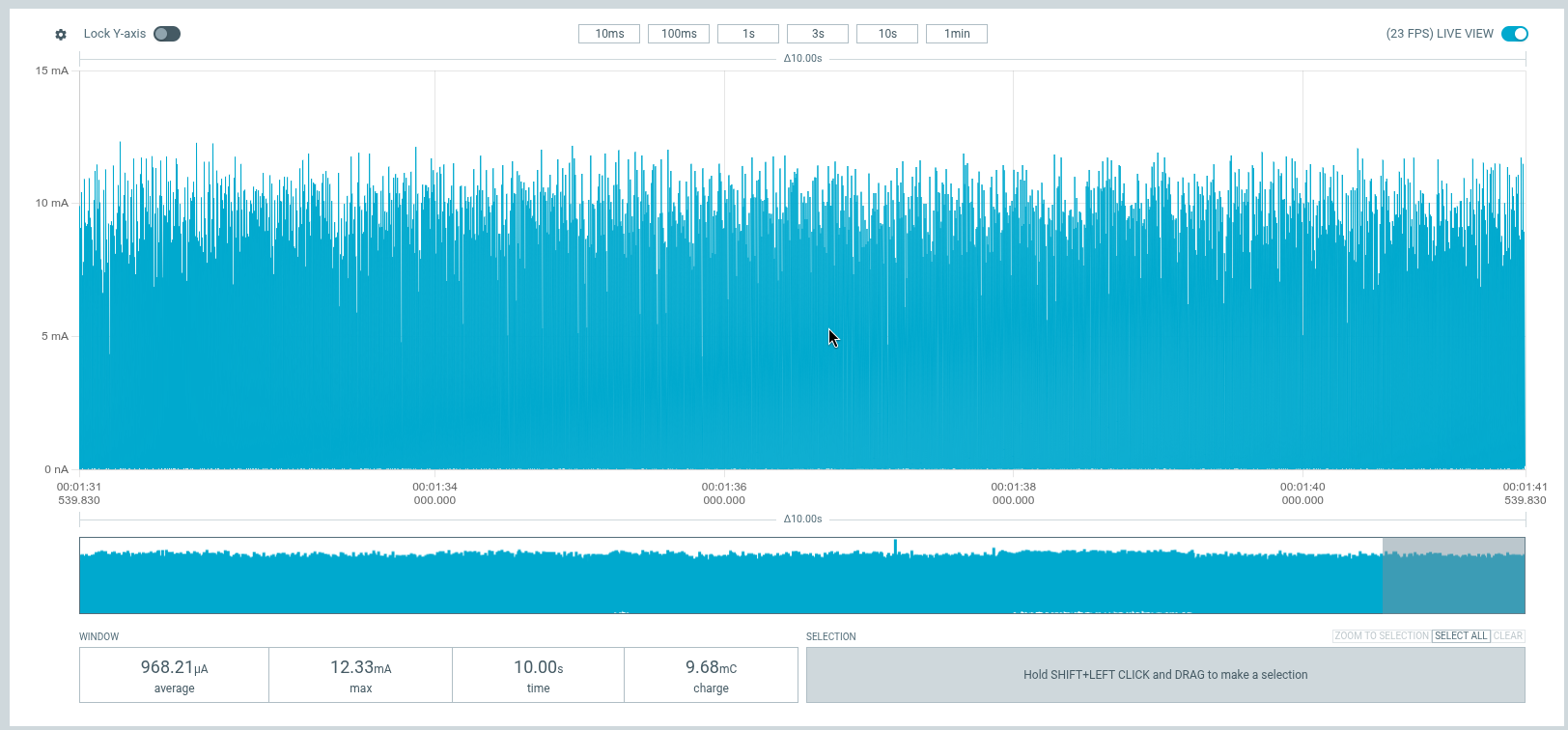
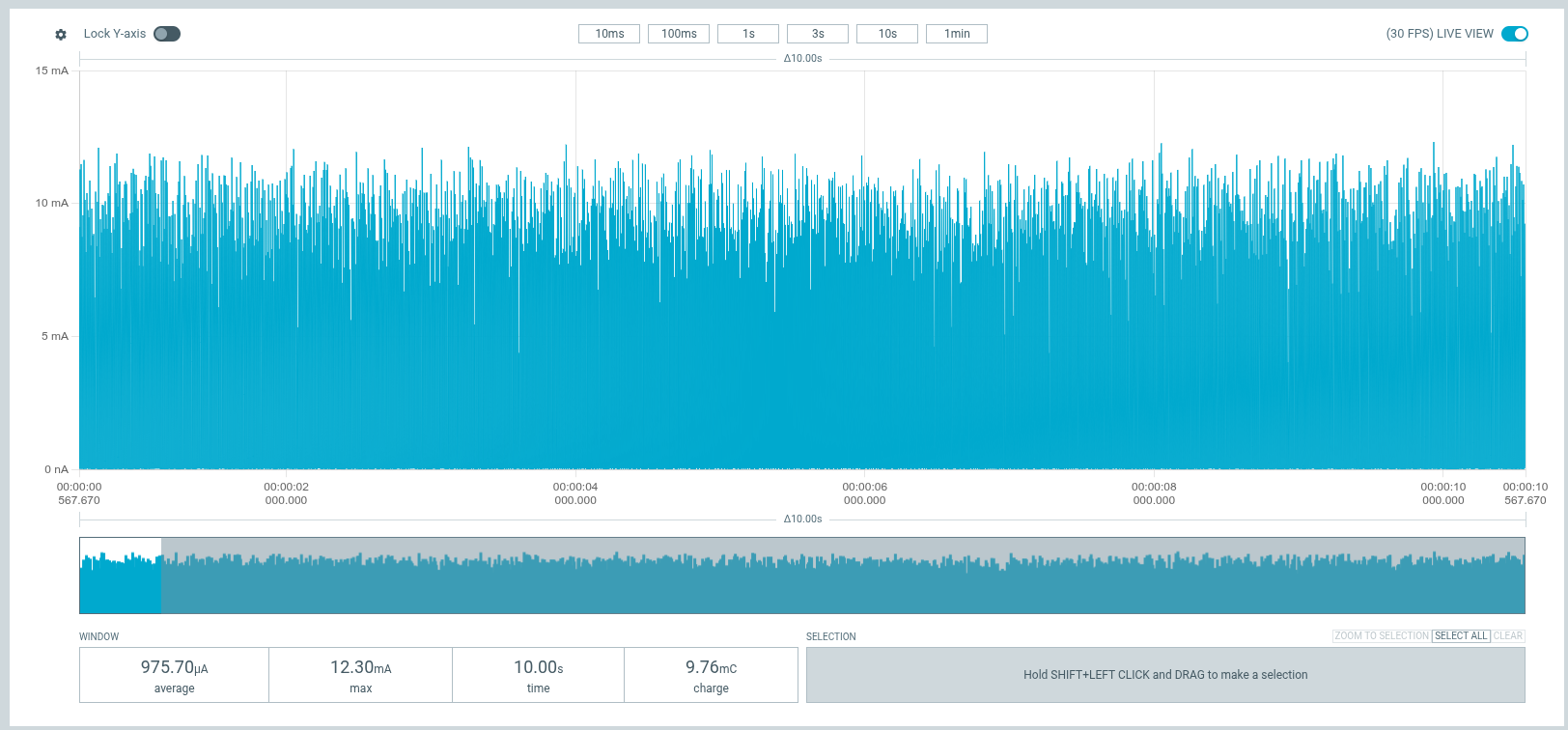
The difference is 7.49 µA, or about 0.77% of baseline. Without repeated runs, I can’t separate that from ordinary variation. There is no demonstrated awake-idle saving in this pair.
That fits the scope of the matrix change: it adds pacing while scanning is active, not a new periodic job while the matrix is idle. It is not proof of which MCU or radio activity remains responsible for the idle average. I also haven’t measured matrix-only and SPIM-only awake idle separately yet.
Now release the key occasionally
Holding a switch is useful for exercising sustained scanning. It is not how I type. With one populated key, the next available experiment was repeatedly tapping F instead.
I tried to keep the manual rhythm as close as possible between baseline and matrix-only. The tap counts were approximately the same, and I kept all other conditions the same. I did not record exact counts or press durations. Every F tap registered.
| Repeated manual F taps | Average current | Maximum | Charge over 10 s |
|---|---|---|---|
| Baseline | 2.66 mA | 12.65 mA | 26.65 mC |
| Matrix | 1.56 mA | 13.92 mA | 15.62 mC |
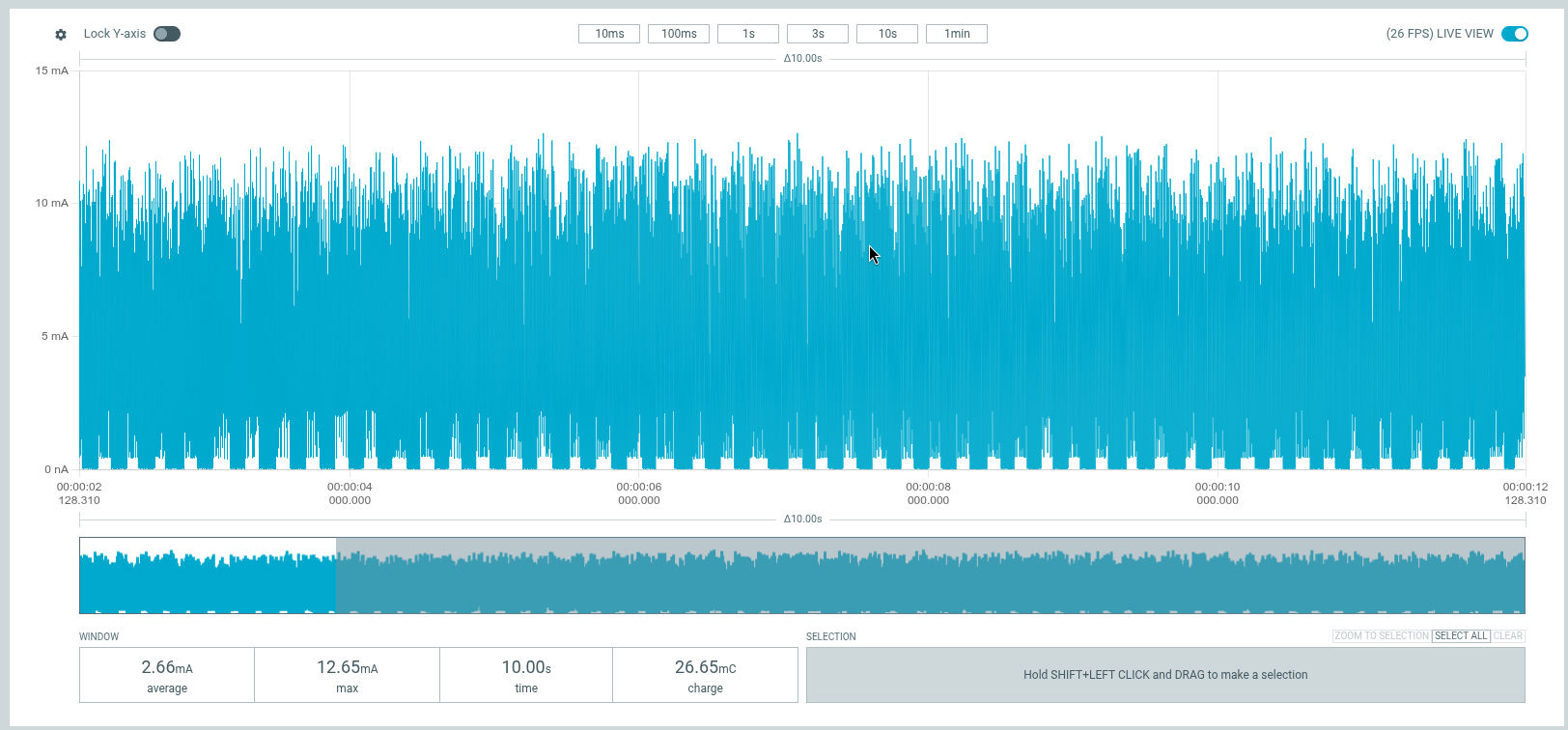
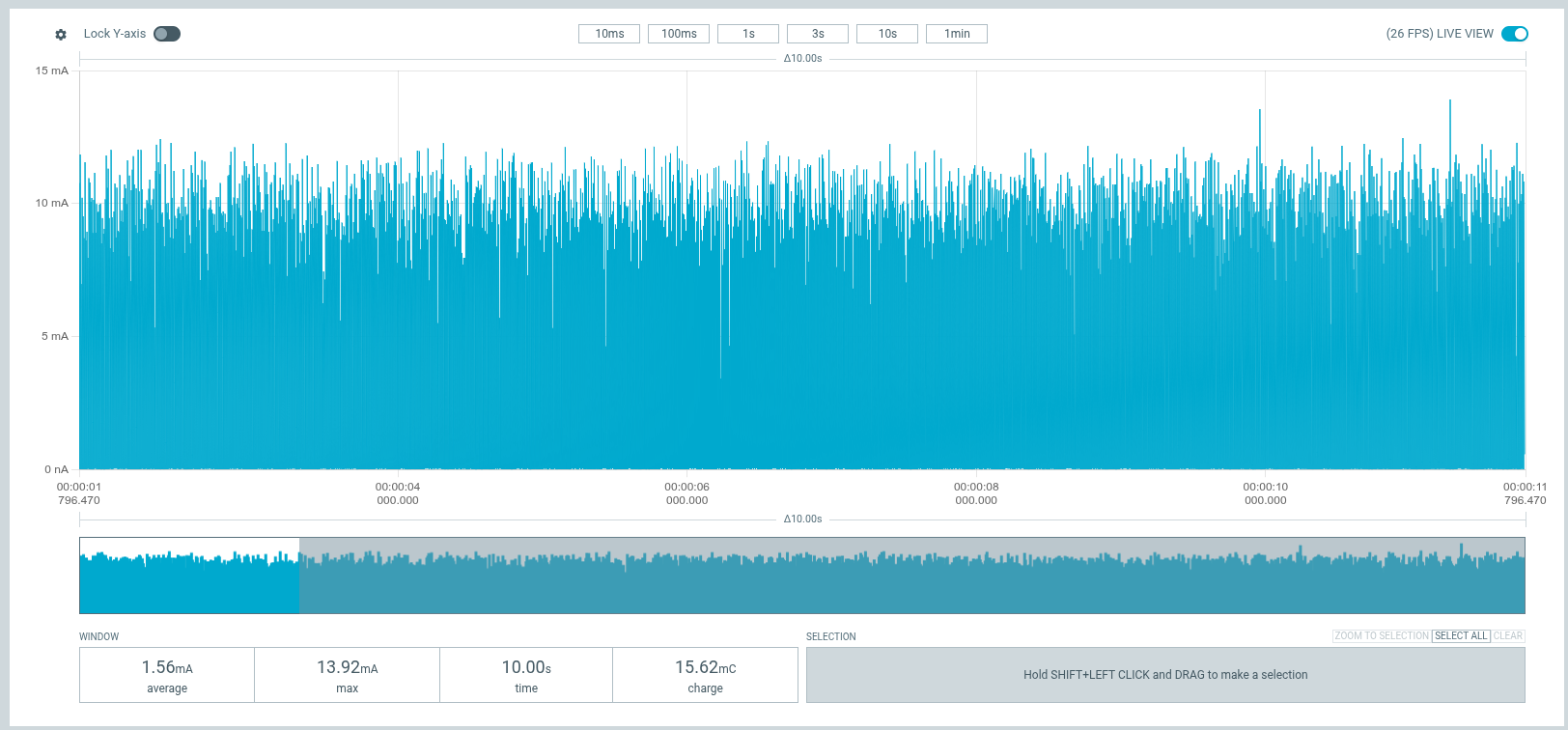
The matrix window contains 11.03 mC less charge, a 41.4% reduction relative to the baseline window. That percentage is a description of these captures, not a repeatable typing-savings estimate accurate to a decimal place.
The same direction in both held-switch and repeated-tap workloads is encouraging. Repeated taps exercise wake, scanning, debounce, and release instead of keeping the scanner active continuously. But manual changes in press duration change how long the scanner stays active. Approximate tap counts aren’t enough to calculate a defensible charge per tap.
Nor does every F registering validate home-row rolls, overlapping keys, layer chords, split delivery, latency, or sleep/wake. That needs the fully populated keyboard.
What if the scan gap did all the work?
Before generalizing the 64-cycle delay, I wanted to answer a simpler question: perhaps the 1 ms pause explained the entire improvement, and replacing the per-output timer hadn’t helped at all.
I built a pacing-only central image. It restores Timer::after_micros(1).await after selecting each output, but keeps the 1 ms active-scan gap and the yield after idle waits. SPIM stays on baseline behavior, and erase-on-boot remains enabled.
This image uses frozen local snapshots of the same Urchin and RMK revisions as the earlier measurements, plus the settling-hunk removal. It doesn’t use the newer upstream branch I started for cleanup. The four RMK packages resolve from that patched snapshot; all other package versions, sources, and checksums remain unchanged. Its source and build records identify that difference rather than calling it an unmodified published RMK build.
| Workload | Baseline average / charge | Pacing-only average / charge | Both matrix changes average / charge |
|---|---|---|---|
| Held physical F | 4.30 mA / 42.98 mC | 3.44 mA / 34.42 mC | 2.07 mA / 20.72 mC |
| Repeated manual F taps | 2.66 mA / 26.65 mC | 2.23 mA / 22.33 mC | 1.56 mA / 15.62 mC |
Each charge figure covers a 10-second window. “Both matrix changes” means short settling plus scan pacing, not the separate both variant that also changes SPIM lifetime.
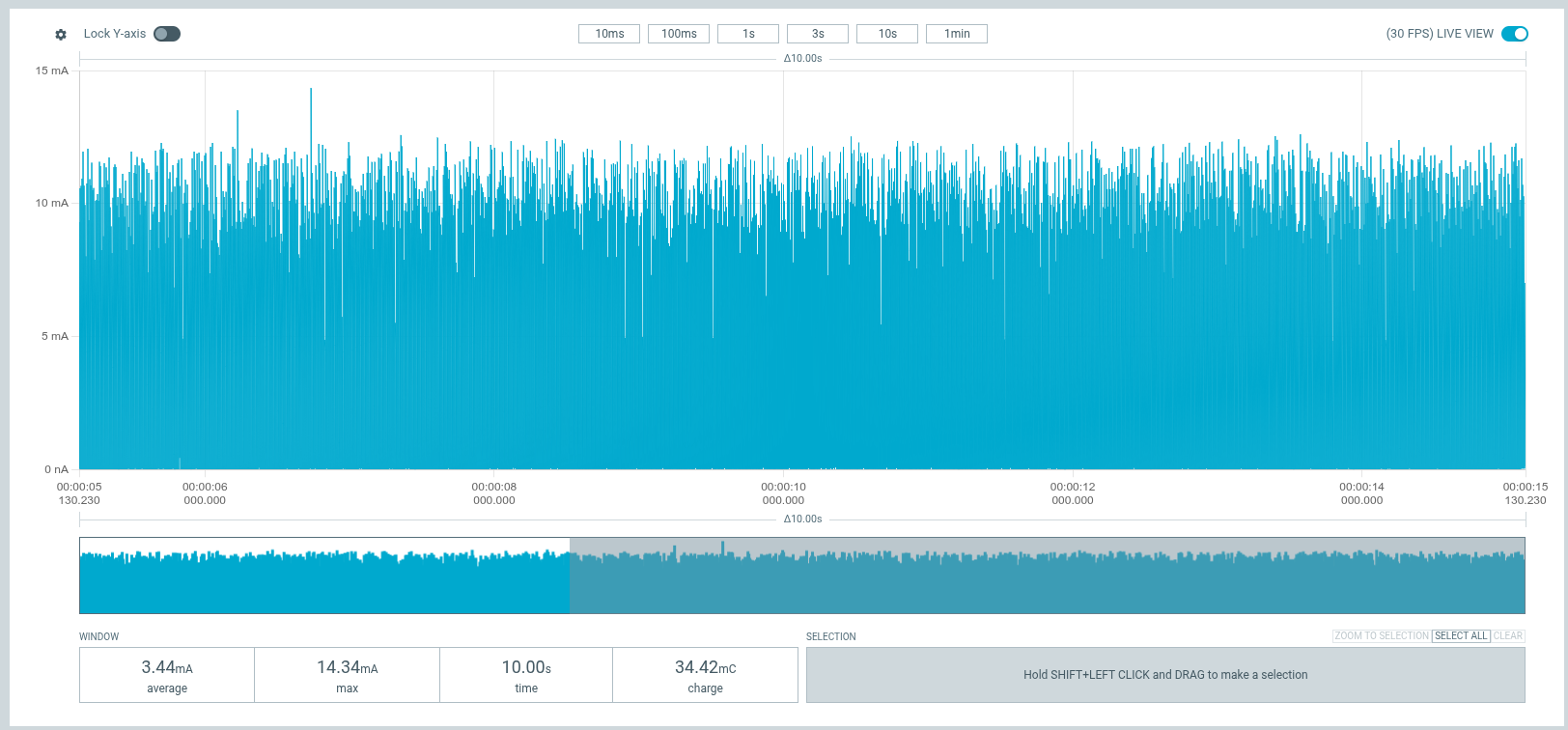
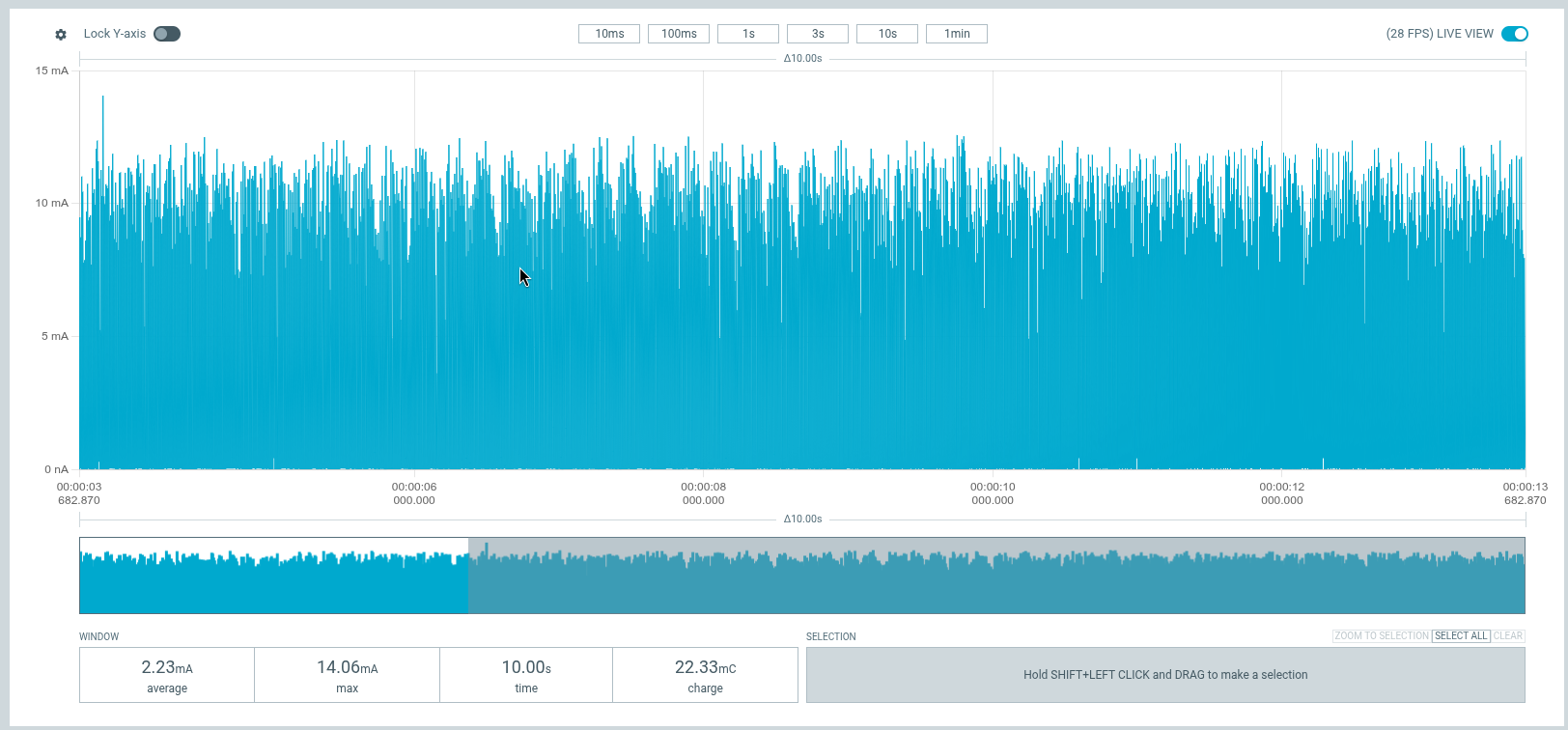
Pacing alone reduced charge by about 20% while held and 16% while tapping, relative to the earlier baseline windows. That is useful, but well short of the roughly 52% and 41% reductions with both matrix changes.
Restoring the per-output timer increased the held-switch average from 2.07 mA to 3.44 mA, and the tapping average from 1.56 mA to 2.23 mA. There is a practical reason to keep investigating the short settling wait, rather than treating it as incidental cleanup.
That comparison measures its benefit with pacing already enabled. I still haven’t measured short settling on its own, or repeated these trials enough to put error bars on the differences. The two changes may interact; this isn’t a way to assign each a fixed number of microamps. The tapping rhythm is still manual, and negotiated BLE parameters were not recorded for every run.
Embassy hasn’t disappeared from the scanner: it still provides the 1 ms pacing timer. What changes is the repeated short wait after each output selection. Avoiding those waits helps in this configuration; the traces alone don’t identify how much comes from timer scheduling, RTC tick quantization, or the work between scans.
Where I stopped
The first active-power captures support a useful, limited conclusion: the matrix timing experiment roughly halves held-switch consumption and reduces charge during approximately matched manual single-key tapping. Pacing-only measurements show a smaller improvement, supporting short settling as an additional benefit when pacing is enabled. The SPIM lifetime experiment shows no useful net benefit in the measured workload. Awake-idle consumption is nearly unchanged.
The measurement summary and table of GUI measurements retain all the numbers, original screenshot hashes, prepared build provenance, and unresolved metadata. There are no raw current exports attached to this set yet; the table is transcribed from the PPK2 GUI, not reconstructed from sample data.
Before publishing a stronger claim, I want repeated alternating baseline/matrix trials, counted taps with a repeatable rhythm, recorded BLE negotiation, and input testing on the full keyboard. The run record also still needs the exact flashed image checksums, measurement role and supply insertion point, peer firmware and connection state, USB/debug connections, display state, and acquisition sample rate. Those details should not be inferred from an older experiment or from the GUI’s live-view frame rate.
There is no battery-runtime table this time. One held switch and a few seconds tapping F don’t tell me how many days a real typing workload will buy. They do tell me where the next experiment is worth spending time: on the scanner, not on making the SPI driver disappear between two-byte display commands.