Revisions: v1.0 vs v1.1
The Pico de Gallo PCB has shipped in two revisions, with a third planned. The revision determines two things:
- Which firmware feature flag you flash (
hw-rev1orhw-rev2). - Which peripherals the firmware exposes.
| Revision | Feature flag | Connector | Capabilities |
|---|---|---|---|
| v1.0 | hw-rev1 (deprecated) | 7 separate pin headers | I²C, SPI, GPIO, PWM |
| v1.1 | hw-rev2 (default) | one keyed 2×12 shrouded header | I²C, SPI, UART, GPIO, PWM, ADC, 1-Wire |
| v2 (future) | hw-rev2 (default) | 2×12 shrouded header + level translators | same as v1.1, plus variable VREF rail |
Important
The capability set is enforced by firmware, not by the hardware. Flashing
hw-rev1firmware onto a v1.1 board still gives you only the v1.0 capability set. Match the firmware to the board you actually have.
hw-rev1 Is Deprecated
hw-rev2 is the default firmware feature. Building the firmware
with no feature flags produces a rev2 image:
$ cargo build --release --target thumbv8m.main-none-eabihf
hw-rev1 is deprecated and must now be requested explicitly:
$ cargo build --release --target thumbv8m.main-none-eabihf \
    --no-default-features --features hw-rev1
Deprecated does not mean unsupported:
- rev1 boards keep working.
hw-rev1is still built and linted in CI on every push, andfirmware-rev1.uf2is still attached to every firmware release. - Removal will not happen before 2031-09-01. That is a floor — five years’ notice — not a commitment to remove on that date.
Two signals fire when you enable it. The build script prints a
cargo:warning naming the removal floor, and the firmware logs a
defmt::warn! over RTT on every boot, so a rev1 image is
identifiable from the device as well as from the build log.
If you are fabricating a board today, fabricate v1.1 and use the
default hw-rev2 firmware.
Which One Should I Pick?
- You only need I²C, SPI, GPIO, or PWM → an existing v1.0 board
is fine and keeps working, but
hw-rev1is deprecated (see above); don’t fabricate a new one. - You need UART, ADC, or 1-Wire → you want v1.1 (or later).
Calling an unsupported endpoint on v1.0 firmware returns
Unsupported. - You’re starting from scratch today → fabricate v1.1. It’s the same effort and a strict superset.
What v1.1 Adds Over v1.0
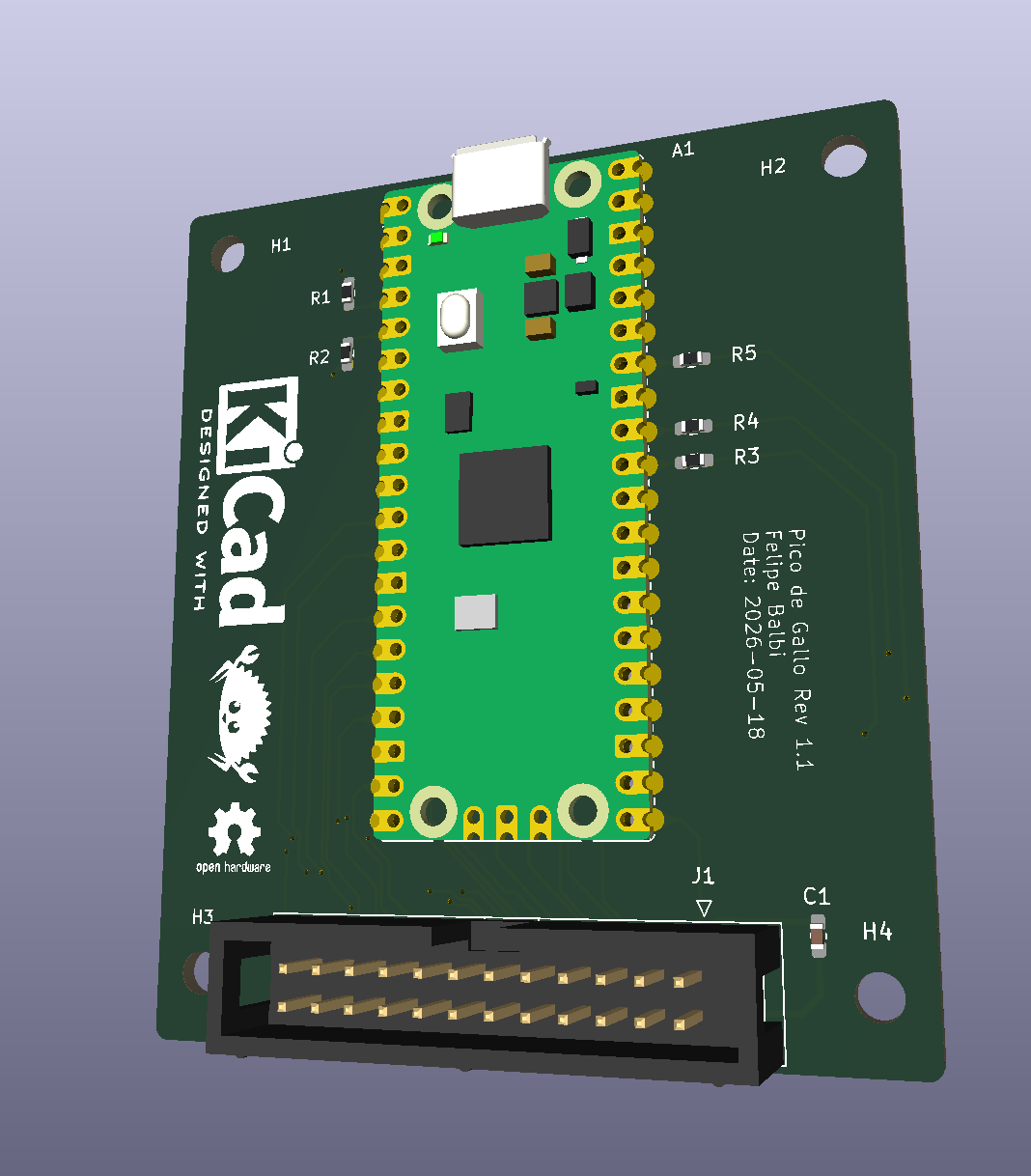
- Single keyed box header. One cable, one orientation, no ambiguity. Adapter boards (informally called “toppings”) can be designed against a stable connector instead of wrangling seven separate jumper bundles.
- All implemented peripheral signals routed. UART, 1-Wire, and the three ADC inputs are physically absent on v1.0. v1.1 also routes the PCB’s SPI_CS net from RP2350 GPIO 5, but that net is a label only — current firmware never claims or drives that pad.
- On-board passives.
- 4.7 kΩ pull-ups on I²C (no more dangling resistors).
- 100 Ω series resistors on each ADC input for protection and a mild RC roll-off.
- 100 nF decoupling on VREF.
What v2 Will Add
Planned but not yet released:
- Variable VREF rail on header pin 1: selectable 1.8 V / 3.3 V / 5 V. On v1.1 this pin is hardwired to 3.3 V.
- Level translators on the digital signals so the same board can talk to 1.8 V, 3.3 V, and 5 V peripherals without an external level shifter.
- Same firmware feature flag as v1.1 (
hw-rev2).
Note
Adapter boards designed for the v1.1 box-header pinout will plug into v2 unchanged. On v1.1 they will see 3.3 V on pin 1; on v2 they will see whatever VREF is set to. Design your topping with that in mind.
v1.0 — Best Effort
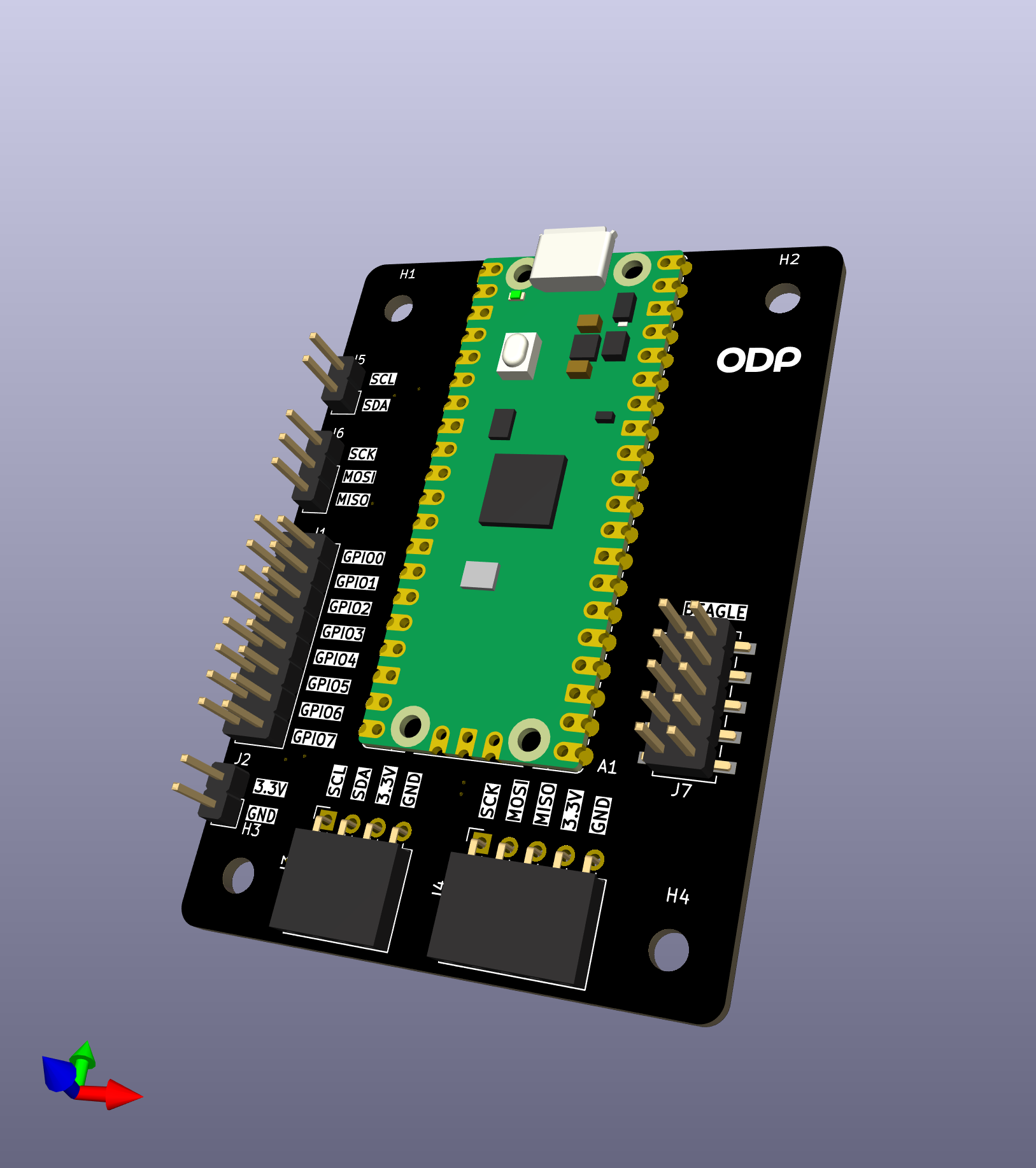
The v1.0 board predates the consolidated header and lacks routing
for UART (GPIO 0-1), 1-Wire (GPIO 16), and ADC (GPIO 26-28).
Firmware validates those endpoints and returns Unsupported, so
calling them won’t crash — you just won’t get data.
If you’re stuck on v1.0 and need one of the missing signals, you can solder a wire directly to the corresponding Pico 2 castellated pad. It’s not pretty, but it works for UART, 1-Wire, and ADC.
SPI_CS is different. Its physical GPIO 5 net is present on the v1.1
header but absent on v1.0, and current firmware does not claim or
drive GPIO 5 on either revision. Soldering to that pad does not make
it usable as firmware-controlled chip-select; use a user GPIO index
reported by device/info instead.
Note that SPI_CS on the v1.1 silkscreen and in the KiCad schematic
is a net label, not a feature. Neither revision provides a working
dedicated chip-select signal, and the misleading label can only be
retired by a future board revision. See
issue #99.
Identifying Your Board
The fastest way to tell what revision firmware you’re running:
$ gallo version
╭─────────────┬──────────────────────────────╮
│ Firmware    │ v0.12.0                      │
│ Schema      │ v0.8.0                       │
│ HW revision │ 2                            │
│ GPIOs       │ 4                            │
│ Build       │ firmware-v0.12.0-42-g1a2b3c4 │
╰─────────────┴──────────────────────────────╯
╭─────┬─────┬──────┬──────┬─────┬─────┬────────╮
│ I2C │ SPI │ UART │ GPIO │ PWM │ ADC │ 1-Wire │
├─────┼─────┼──────┼──────┼─────┼─────┼────────┤
│ ✓   │ ✓   │ ✓    │ ✓    │ ✓   │ ✓   │ ✓      │
╰─────┴─────┴──────┴──────┴─────┴─────┴────────╯
HW revision 1 corresponds to hw-rev1; 2 corresponds to
hw-rev2. The capability table tells you exactly which peripherals
this firmware will serve.
Migrating from v1.0 to v1.1
Code-wise, nothing changes. The wire protocol is the same; the host crates are the same; the CLI is the same. The only thing that moves is which physical pins your peripheral cables plug into — see Pinout & Connector.
If you have driver code that detects capabilities at runtime, use
device_info() (host) / gallo_get_device_info (FFI) and gate on
the capabilities bitfield. That way the same binary works
unmodified on both boards.